If you are managing traffic enforcement for a smart city project or overseeing vehicle access at a high-security facility, you already know that manual surveillance does not scale. Registers get missed. Hotlisted vehicles pass through unchecked. Violations pile up without e-challans ever being issued. The real question is no longer whether you need Automatic Number Plate Recognition, but how to deploy it in a way that holds up across Indian road conditions, integrates with government databases, and delivers round-the-clock accuracy.
This blog covers the operational framework behind ANPR deployments in India, the challenges the technology solves across traffic, access control, and public safety, and what to evaluate before large-scale rollout.
India’s vehicle population has crossed hundreds of millions, with registrations growing rapidly across Tier 2 and Tier 3 cities, putting unprecedented pressure on traditional, manual traffic enforcement systems. At a single four-lane intersection, thousands of vehicles pass through every hour. Registering number plates by eye, matching them against hotlists, and generating violation records manually is not just slow. It introduces errors, gaps, and delays that directly impact enforcement outcomes.
Consider a stolen vehicle alert issued at 11 PM. With manual checkpoints, the alert reaches field personnel through radio, who then visually scan plates under poor lighting. The lag between alert and interception can be hours, by which point the vehicle has crossed jurisdictions.
An AI-powered number plate recognition system changes this entirely. It captures and reads plates in real time, cross-references them against hotlists within seconds, and triggers instant alerts for on-ground teams. This is exactly how traffic police departments across multiple Indian smart cities have started closing the gap between detection and response supported by 10 Years of Smart Cities Mission
Modern ANPR systems built for Indian conditions go well beyond basic optical character recognition. They use deep learning models trained on the wide diversity of Indian number plates, including non-standard fonts, regional scripts, plates obscured by dust or rain, and plates captured at varying angles.
Here is what a deployment-ready ANPR framework typically involves across three core use cases:
For smart city and traffic police deployments, the primary objective is automated violation detection paired with enforceable outcomes. The system captures plate data, matches it against the VAHAN and SARATHI databases maintained by NIC, and issues e-challans without manual intervention.
What gets automated:
Each event is backed by:
For law enforcement and highway operators, the value of ANPR lies in real-time vehicle tracking across multiple locations. When a vehicle is reported stolen or flagged in a criminal investigation, its plate is added to a centralized hotlist. Every ANPR camera in the network then watches for that plate continuously.
The moment a match is detected, the system generates an instant alert with the vehicle’s location, direction of travel, and timestamp. This capability has proven operationally significant for traffic police departments running integrated command and control centres (ICCCs), which are now operational in all 100 Smart Cities under MoHUA’s mission and serve as the nerve centres for real-time urban monitoring and response coordination.
Beyond traffic, ANPR is increasingly deployed at airports, industrial facilities, government buildings, and corporate campuses for automated vehicle access control. The system maintains an authorized vehicle database and grants or denies entry based on real-time plate recognition.
When paired with under-vehicle scanning and video analytics at the same entry point, this creates a multi-layered security checkpoint that requires no manual verification. Authorized vehicles pass through seamlessly while unauthorized or blacklisted vehicles trigger immediate alerts to the security operations centre. This layered approach is critical for aviation facilities, enterprise installations, and critical infrastructure sites handling thousands of vehicle entries daily.
Many ANPR vendors can demonstrate plate reading in controlled conditions. The real test is sustained performance across Indian road realities. Here are the factors that determine whether a system will hold up from pilot to full-scale deployment.
The system must connect with NIC’s VAHAN and SARATHI databases to pull real-time vehicle registration and driving licence data. Without this integration, e-challan generation remains a manual, error-prone process. Systems that support this integration natively reduce deployment timelines and eliminate the need for custom middleware.
A single intersection pilot is one thing. Scaling to hundreds of cameras across a city with centralized monitoring is another. The architecture needs to support multi-location deployments with a unified command dashboard, remote reporting, and the ability to process millions of plate reads daily.
The most effective deployments do not treat ANPR as a standalone product. They integrate it with video analytics for incident detection, speed violation systems, under-vehicle scanners, and other traffic monitoring solutions as needed. This modular approach lets authorities start with traffic enforcement and expand to full-spectrum urban surveillance without replacing core infrastructure.
Selecting a vendor is not just about technology specifications. It is about proven performance in Indian conditions, integration readiness, and the ability to scale without friction.
Platforms like Vehant Technologies’ Okean VehiScan ANPR system are built with these requirements in mind. Incubated at IIT Delhi and backed by over 20 years of experience in AI-driven security and traffic solutions, the platform is deployed across 10,000+ lanes, mapping over 40+ million vehicles daily for smart city ICCCs, state police departments, and highway operators nationwide.
Whether you are planning your first ANPR pilot or expanding an existing network to city-wide coverage, the framework above gives you clear evaluation criteria. The technology is proven, the integrations are mature, and the operational impact is measurable from day one.
How does ANPR technology work in Indian traffic conditions?
ANPR uses AI-powered cameras and deep learning OCR to read vehicle plates in real time, even with non-standard fonts, dust, rain, and low lighting common on Indian roads.
Can ANPR systems integrate with VAHAN and SARATHI databases?
Yes. Deployment-ready ANPR platforms connect natively with NIC’s VAHAN and SARATHI databases, enabling authorities to generate e-challan with verified vehicle owner details.
What role does ANPR play in smart city traffic enforcement?
ANPR automates violation detection, including red light and stop line breaches, and feeds real-time data to integrated command and control centres for centralized city-wide enforcement.
How is ANPR used for vehicle access control at high-security premises?
ANPR verifies vehicles against an authorized database at entry points, granting or denying access automatically. It integrates with under-vehicle scanning for multi-layered perimeter security.
What accuracy can ANPR systems achieve in real-world Indian deployments?
Leading ANPR systems deliver higher accuracy across varying speeds, lighting, and weather conditions, using adaptive AI models trained on Indian plate diversity.


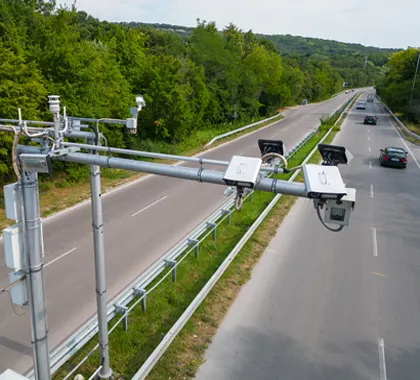
Speeding remains one of the most persistent threats on modern roads. It shortens reaction time, extends braking distance, and turns routine commutes into serious crashes. As cities grow denser and...
read more

Today numerous cities in India are rapidly moving towards a future that is smart and urbanized. The only mission these cities have is to make use of technology in a...
read more
Deep tech innovation now serves as the primary technological foundation that supports modern infrastructure development, with multiple advanced technologies, such as artificial intelligence (AI), intelligent surveillance systems, automation technologies, and...
read more

 +91-120-4610200
 contact@vehant.com