Speeding remains one of the most persistent threats on modern roads. It shortens reaction time, extends braking distance, and turns routine commutes into serious crashes. As cities grow denser and highways carry heavier traffic loads, manual enforcement can no longer keep pace with the sheer volume of vehicles on the network. The gap between violations committed and violations penalised keeps widening every year.
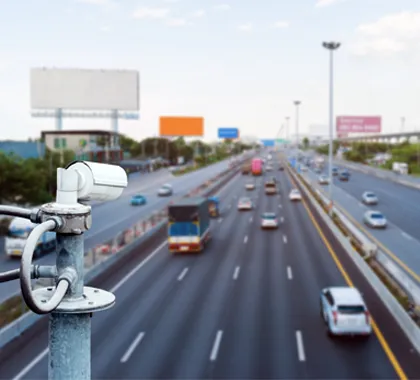
This is where Speed Violation Detection Systems (SVDS) step in. Modern SVDS platforms combine artificial intelligence, machine learning, high definition cameras, and radar technology to monitor traffic in real time, identify over-speeding vehicles, and automate the entire enforcement workflow. Vehant Technologies, through its OKEAN® TrafficMon® AI/ML Platform, has built one of the most advanced speed detection ecosystems in India, fully aligned with national highway standards.
Every kilometre per hour above the safe limit multiplies the severity of a collision, and the data reflects that risk.
Traditional enforcement methods struggle against this scale. Patrol vehicles with handheld radar guns and manual speed checks depend entirely on human capacity. Officers can only cover a small stretch of road at any moment. Offenders slow down the instant they spot a check point and speed up again once past it.
Paper based challan issuance is also slow and prone to disputes. On multi lane expressways carrying thousands of vehicles per hour, this reactive approach leaves the vast majority of violations undetected. Repeat offenders quickly learn that the odds of being caught in person are low enough to ignore.
A Speed Violation Detection System is an intelligent traffic enforcement solution that automatically measures the speed of every vehicle on a road. It identifies those exceeding the permitted limit, captures visual evidence, and forwards violation data for challan generation. Vehant’s Radar Based Speed Violation Detection System, a core offering under the OKEAN® TrafficMon® AI/ML Platform, delivers this capability through AI powered video and 4D radar based technology.
Alongside speed, the system captures direction of travel, vehicle classification, and license plate information in a single pass. It is fully compliant with NHAI guidelines and its speed accuracy is certified by authorised Indian government agencies including ARAI. These certifications matter because they make the violation data legally admissible for e-challan issuance and remove the ground on which disputes are usually raised.
Vehant’s platform relies on two complementary technologies. Video based detection uses computer vision and deep learning on high definition camera feeds to calculate the instantaneous speed of a moving vehicle by analysing the time and distance it travels between frames.
Radar based detection uses 4D imaging radar to measure speed, direction, range, and lane position across multiple lanes at once. It also continues to perform reliably in rain, fog, and low visibility where cameras alone can struggle.
Both variants are built for high speed environments. The OKEAN® TrafficMon® Video SVD reads speeds up to 300 km per hour, while the OKEAN® TrafficMon® Radar SVD extends that ceiling to 320 km per hour.
Once a violation is detected, the system captures a still image or short video clip of the offending vehicle as evidence. Automatic Number Plate Recognition (ANPR) then extracts the license plate and cross checks it against connected databases for stolen, hot listed, or wanted vehicles. The complete record is pushed to a centralised traffic dashboard or ATMS, where an e-challan is generated automatically within minutes.
A key preventive feature layered on top of this workflow is the Vehicle Actuated Speed Display (VASD). It shows drivers their real time speed as they approach the enforcement zone and issues dynamic textual or graphical alerts to over speeding vehicles. This visual deterrent often prevents the violation from occurring in the first place.
Automated systems do not tire, do not get distracted, and do not require breaks. They monitor every vehicle in every lane, every hour of every day, in every weather condition. This consistency changes driver behaviour in a way that occasional manual checks never can, because motorists learn that the risk of being caught is no longer a matter of luck.
The VSDS supports in depth data logging and traffic analytics, enabling authorities to identify high risk stretches and recurring violation patterns by location, time of day, and vehicle category. Cities and highway operators can then place additional signage, adjust posted speed limits, redesign accident prone junctions, or deploy resources exactly where the evidence shows they are most needed.
The VSDS integrates seamlessly with ATMS platforms and centralised dashboards, and supports third party integration. Speed enforcement data flows into the same environment used for incident detection, tolling, and traffic flow management, giving authorities a unified operational picture rather than isolated silos of information that have to be reconciled manually.
Equipped with auto diagnostic and self calibration functions, the VSDS keeps itself operationally ready with minimal human intervention. Field technicians are only called out when something genuinely needs attention, which translates into significantly lower maintenance costs and higher enforcement availability over the deployment lifetime. For long stretches of highway where site visits are logistically expensive, this reliability directly protects the return on investment.
Vehant’s speed detection technology is deployed across environments where speed related risk is highest. National highways and expressways rely on it for NHAI compliant enforcement of overspeeding and related violations, particularly on long straight stretches where drivers tend to push beyond safe limits. Smart cities use the same platform to make intersections and arterial roads safer, where mixed traffic and pedestrian activity make speed control especially important. Airports, sports complexes, and industrial zones apply it wherever vehicle speed must be strictly regulated inside a controlled perimeter.
As part of the broader OKEAN® platform, VSDS works alongside modules such as VIDES, MLFF, ATCC, TMCS, and VMS. Together they give authorities a complete automation stack covering incident detection, tolling, traffic counting, and video management from the same technology backbone. This shared foundation is what allows a single control room to run large scale enforcement without adding proportional headcount.
The strongest case for automated speed enforcement is a practical one. It scales, it holds up in court, it learns from its own data, and it works when human enforcement cannot. For traffic authorities, highway operators, and smart city administrators, a certified, NHAI compliant solution like Vehant’s OKEAN® TrafficMon® VSDS is one of the most direct paths forward. It reduces fatalities, cuts violation processing time, and builds public confidence in road safety enforcement. As traffic volumes continue to grow, the real question is no longer whether to automate speed enforcement, but how quickly to roll it out.
A Speed Violation Detection System is an automated traffic enforcement solution that measures vehicle speed in real time, identifies over speeding vehicles, and captures photographic evidence for challan generation. Vehant’s Vehicle Speed Detection System (VSDS), part of the OKEAN® TrafficMon® AI/ML Platform, uses AI powered video and 4D radar technology to detect violations, read license plates, and support automated enforcement fully aligned with NHAI guidelines.
Vehant’s Vehicle Speed Detection System is certified by authorised Indian government agencies including ARAI. The OKEAN® TrafficMon® Video SVD reads speeds up to 300 km per hour, while the Radar SVD covers up to 320 km per hour with high accuracy. This certification ensures violation data is legally admissible for e-challan issuance and dispute free enforcement.
Yes. Vehant’s Okean 4D Radar based Speed Violation Detection System is engineered to detect vehicle speed, direction, and classification across multiple lanes in all weather conditions, including rain, fog, and low visibility. The video based system also uses advanced computer vision and deep learning to maintain accuracy across varying lighting and traffic conditions, ensuring continuous 24 by 7 enforcement on highways and urban roads.
Video based SVDS uses AI and computer vision on HD camera feeds to calculate speed by analysing time and distance travelled by a vehicle across frames. Radar based SVDS uses 4D imaging radar to measure speed, direction, and range across multiple lanes simultaneously and performs strongly in adverse weather. Vehant offers both, allowing authorities to choose or combine solutions based on road type, budget, and environmental conditions.
Yes. Vehant’s Vehicle Speed Detection System is capable of generating alerts for hot listed, stolen, and wanted vehicles. When the integrated ANPR module reads a license plate, the system cross checks it against the connected database in real time. If a match is found, an immediate alert is sent to traffic control rooms, helping law enforcement act quickly and enhancing overall road and public security.
Absolutely. Vehant’s Vehicle Speed Detection System is fully compliant with NHAI guidelines and is a core module of the OKEAN® TrafficMon® AI/ML Platform used across major highway projects. It captures vehicle speed, direction, classification, and license plate information as required for enforcement on national highways. Compliance ensures that operators can deploy the system with confidence for both tolling corridors and expressway enforcement projects.
The Vehicle Actuated Speed Display is a key feature of Vehant’s VSDS. It shows drivers their real time speed and issues dynamic textual or graphical alerts to over speeding vehicles as they approach. This immediate visual feedback acts as a strong deterrent, encouraging drivers to voluntarily reduce speed before any violation is recorded, and helping reduce accident risk in high speed and accident prone zones.
Yes. Vehant’s Okean SVD integrates seamlessly with ATMS and centralised dashboards, automating violation processing and reporting. It also supports third party integration, allowing traffic authorities to connect the system with existing e-challan portals, control rooms, and analytics platforms. This unified approach ensures speed violation data flows directly into the same environment used for tolling, incident management, and citywide traffic operations.
Vehant’s Speed Violation Detection System is deployed across national highways, expressways, smart city road networks, airports, sports grounds, and industrial zones. Under the OKEAN® platform it works alongside modules like VIDES, MLFF, ATCC, TMCS, and VMS to deliver complete highway and urban traffic management. Any environment where vehicle speed must be regulated and enforced can benefit from the platform’s flexible video and radar based configurations.
Vehant Technologies is a pioneer in AI and ML based traffic monitoring, surveillance, and enforcement solutions, designed and developed in India. Its Vehicle Speed Detection System is NHAI compliant, ARAI certified, and equipped with auto diagnostic and self calibration functions for high uptime. With proven deployments across highways and smart cities and integration into the wider OKEAN® TrafficMon® ecosystem, Vehant offers a trusted, scalable, and future ready choice.



Deep tech innovation now serves as the primary technological foundation that supports modern infrastructure development, with multiple advanced technologies, such as artificial intelligence (AI), intelligent surveillance systems, automation technologies, and...
read more
If you are managing traffic enforcement for a smart city project or overseeing vehicle access at a high-security facility, you already know that manual surveillance does not scale. Registers get...
read more

Today numerous cities in India are rapidly moving towards a future that is smart and urbanized. The only mission these cities have is to make use of technology in a...
read more

 +91-120-4610200
 contact@vehant.com